Overconfidence Bias, The Kentucky Derby, and the Perils of Too Much Information
What was Reinforced during our Weekend at Churchill Downs
By: Philip “Flip” O’Toole, CIMA®
“When given 5 pieces of information, bettors were 17% accurate and 19% confident. With 40 pieces of information, accuracy stayed at 17%, but confidence jumped to 34%.”
- Paul Slovic, Psychologist (1974)
1. A Bucket List Item Checked Off
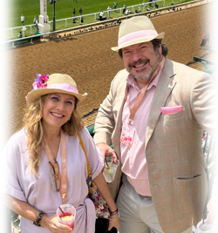
One of the joys of being “empty nesters” is being able to pivot at a moment’s notice if duty calls. For example, a friend called the Sunday before The Kentucky Derby this year asking if my wife and I could help him out of a jam. He had a last-minute unavoidable cancellation and wanted to know if we could take two extra “Derby Experience” passes off his hands for the upcoming weekend? Hmmm, can we think about it for a…we are in!!!
The weekend in Louisville and Churchill Downs was everything we imagined and more. The setting. The people. The attire. The majesty of the horses. The energy. The company. Some random highlights included my wife bumping into and falling in love with the Founder and President of Barstool Sports, Dave Portnoy, who agreed to a “selfie” with her. I was also able to eavesdrop on a conversation between Mr. and Mrs. Ted Cruz as she was dragging him out of a conversation while he feebly pleaded “honey, I was just talking to Rand”. Even US Senators answer to higher power…
But I think my favorite part of the weekend was simply the cadence of race day. While most of America only sees The Kentucky Derby run live on NBC around 7pm, those at Churchill Downs are treated to 15 races on Friday during The Kentucky Oaks and 14 races on Saturday, Derby Day. Our cadence was to arrive early, grab a program, a table and make sure the betting app was downloaded and ready to go on our smart phones. Once bets are placed, it’s time to head over to the grandstands to watch a race.
There are two minutes of wild excitement as our horse either finishes in the money and we celebrate, or dejected, we immediately look down at the program to start preparing for the next race. At that point, it’s time to head back to our table, grab a mint julip and a plate of food, tell stories with our friends for the next 30-50 minutes between races while studying and preparing another bet. Wash, rinse repeat all day, for two days. It was glorious!
As my Wealth Management brain is always on high alert, even subconsciously during such a weekend, I couldn’t help but be fascinated by the entire horse track gambling process. It immediately recalled a study I learned of early in my career that was conducted by psychologist Paul Slovic in 1974 and that many refer to as “the perils of too much information” study.
2. Is Less Really More?
Slovic set out to study the success rate of horse racing handicappers. His goal was to evaluate how adding information affects the accuracy of human decisions and the confidence of the decision-maker. In his study, he found the accuracy of horse racing gamblers peaked at 17% with 5 pieces of information then flatlined, even as more pieces of information were added.
What continued to increase, however, was confidence, which ticked up linearly as each piece of information was added. Confidence started at 19% with five pieces of information, but unlike accuracy continued to increase as more information was added, eventually peaking at 34% with 40 pieces of information. Once you understand the conclusion of this study, then you can understand why horse racing guides include so much information.
Slovic’s conclusion was that beyond a few important pieces of data, there are diminishing returns to gathering more information at the horse track. Once a handful of the most critical data points are known, continuing to gather even more information serves no other purpose than to increase confidence. After two days and 29 races, I can confidently say I agree with Slovic that having more information does not increase accuracy. I also agree that gathering more information did build our confidence. Moreover, I actually felt there were two biases at play throughout the weekend, “Overconfidence Bias” and “Confirmation Bias”.
Here is what I mean. Typically, we would settle on a horse we favored with just a few pieces of information:
· Horse’s Name
· Jockey
· Trainer
· Odds
From there, my brain would seek a few additional data points that would support my already-made decision including:
· Owner
· Recent order of finishes
· Times in races with similar distances
The first four pieces of information created the confidence needed for a decision, aka Overconfidence Bias. The additional pieces of information simply helped confirm the decision already made, aka Confirmation Bias.
We see similar patterns of Overconfidence bias regularly in Wealth Management, often coupled with Confirmation bias, both are usually the result of too much information. Overconfidence alone can lead to poor decision-making. Combined, they can be a devastating tandem.
In the big race, we settled on 4-1 favorite Renegade to win The Kentucky Derby. What we could not account for in our exhaustive analysis was a 23-1 longshot named Golden Tempo passing 19 horses down the stretch including Renegade at the finish line, despite not having many data points in the program that would suggest he could run with the favorites.
The bad news about gambling is the odds are not in your favor over the long-term. However, the biases that cripple gamblers can also appear when it comes to investing and planning decisions.
3. Wisdom over Information
Today, human beings have more computing power and access to information at their fingertips than ever before. As a result, overconfidence bias can be a challenge for Wealth Advisors and the families they counsel in 2026. As Mark Twain said, “it ain’t what you don’t know that gets you into trouble. It’s what you know for sure that just ain’t so.” Below are just a few examples of what people “know for sure” that can lead them down a wrong path:
· “Stocks are risky.”
· “Bonds are safe.”
· “Deferring taxes is always best.”
· “I make too much money to make Roth contributions.”
· “I am properly diversified and allocated.”
· “This time is different.”
As a partner in a Wealth Management practice, one might think we lean heavily on our Business/Finance degrees to be good at our jobs. In college, we studied economics, accounting, statistics, quantitative analysis, corporate finance, capital markets, risk management, etc… We certainly lean on that education in our jobs daily. However, looking back 30 years later, it would have been nice to have sprinkled in some Psychology courses around human behavior.
Oftentimes in Wealth Management, the challenge isn’t intellectual. It’s emotional. The key to helping families achieve their hopes and dreams is not about knowing. It’s about doing. A good Wealth Advisor knows the prudent path forward. A great Wealth Advisor perpetually motivates the families they counsel to get on the prudent path and stay there regardless of outside noise which is abundant and relentless.
One key is to focus on what matters most and tune out the white noise. As the great jazz artist Miles Davis said, “I always listen to what I can leave out”. Financial Services legend Nick Murray said it another way. He said great advice is about “places in the heart vs places on some chart”. In Wealth Management, it boils down to a handful of questions. Everything else is just noise.
1. Where are you now?
2. Where would you like to go?
3. What resources/levers do you have at your disposal?
4. Are you willing/able to adjust and/or pivot if necessary?
Overconfidence bias tries to crowd out both these questions and the answers, while revealing itself in multiple ways. Overconfidence can cause investors to either be overly reckless or overly cautious, depending on the people and/or the circumstances. The job of the prudent Wealth Advisor is to recognize biases like overconfidence when it appears and steer the conversation back to what matters most, the clients goals, dreams and aspirations and whether their behavior aligns with their vision.
If there is any truth in the Slovic study, then human beings are more confident today in their decision-making than ever before while the accuracy of their decisions remains woefully underwhelming. Now more than ever, the world is drowning in information yet still starved for wisdom. Knowing is easy. Information abounds. Confidence is high. Great Wealth Management is about activating the right behavior in the face of powerful biases which are trying relentlessly to steer us in the wrong direction. And when the narrative changes yet again and a different bias is activated, stay on the path.
The views and opinions expressed herein are those of the author(s) noted and may or may not represent the views of Lincoln Investment. These views are as of June 15, 2026 and are subject to change based on subsequent developments. The material presented is provided for informational purposes only. Information is based on sources believed to be reliable; however, their accuracy or completeness cannot be guaranteed. Nothing contained herein should be construed as a recommendation to buy or sell any securities. As with all investments, past performance is no guarantee of future results. No person or system can predict the market. All investments are subject to risk, including the risk of principal loss.